Flooring Squareness Checker
Verify if your room corners are perfectly square using the 3-4-5 rule (Pythagorean theorem).
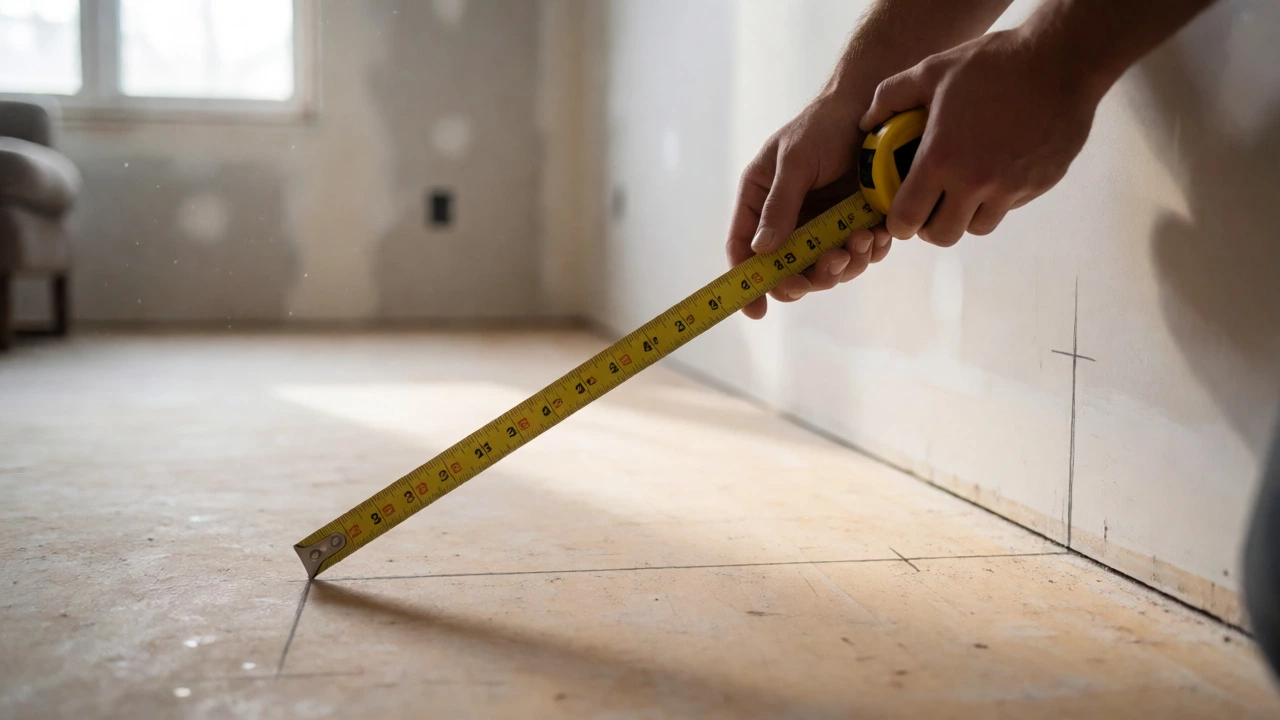
Measure from the corner along one wall (Side A) and the adjacent wall (Side B). Then measure the straight-line distance between those two marks (Diagonal).
Enter measurements to see if your corner is square.
You’ve bought the wood. You’ve prepped the subfloor. But before you snap that first chalk line or lay down a single plank, there’s a tiny geometric secret that separates amateur DIY disasters from pro-level finishes: the 3-4-5 rule a practical application of the Pythagorean theorem used to ensure corners are perfectly square at 90 degrees. If your room isn’t square, your flooring will look wrong no matter how expensive the materials are.
| Concept | Why It Matters | Action Step |
|---|---|---|
| Square Corners | Prevents "bowing" or uneven gaps at walls | Measure diagonals; adjust until equal |
| Pythagorean Theorem | Mathematical basis for the rule (a² + b² = c²) | Use 3ft, 4ft, and 5ft measurements |
| Chalk Lines | Establishes the starting point for planks | Snap lines parallel to the longest wall |
Why Your Room Might Not Be Square
Here’s the uncomfortable truth about most homes, especially older ones in Vancouver or anywhere else: rooms are rarely perfect rectangles. Walls bow, foundations settle, and builders cut corners-literally. If you start laying hardwood flooring a type of flooring made from timber trees, valued for its durability and aesthetic appeal straight against one wall without checking the opposite side, you’ll likely end up with a gap that widens as you move across the room. By the time you reach the far wall, your last row might be a sliver too narrow to fit, or worse, visibly angled.
The 3-4-5 rule flooring technique solves this by giving you a quick, tape-measure-only method to verify if a corner is truly 90 degrees. It doesn’t require fancy laser levels or complex trigonometry. Just three numbers: 3, 4, and 5.
How the 3-4-5 Rule Works
This method is rooted in the Pythagorean theorem a fundamental principle in Euclidean geometry relating the lengths of the sides of right-angled triangles. In simple terms, if you have a triangle where one side is 3 units long, another is 4 units long, and the hypotenuse (the diagonal) is exactly 5 units long, the angle between the two shorter sides must be 90 degrees.
For flooring, you don’t need inches or centimeters-you can use feet. Here’s the step-by-step process:
- Mark the Corner: Start at the corner where you plan to begin laying your floor. Measure 3 feet along one wall and make a mark. Measure 4 feet along the adjacent wall and make another mark.
- Measure the Diagonal: Now, measure the distance between those two marks. This is your hypotenuse.
- Check the Result: If the distance is exactly 5 feet, your corner is square. If it’s less than 5 feet, the corner is acute (less than 90 degrees). If it’s more than 5 feet, the corner is obtuse (more than 90 degrees).
If your corner isn’t square, don’t panic. You don’t need to rebuild the house. You just need to adjust your starting line. Instead of running your first row parallel to the wall, you’ll run it perpendicular to the diagonal centerline of the room, ensuring the floor looks balanced even if the walls aren’t.
Finding the Center Line for Uneven Rooms
In many cases, checking individual corners isn’t enough. If the room is a parallelogram (slanted), you need to find the true center. This is crucial for laminate flooring a multi-layer synthetic flooring product fused together with a lamination process or tile, where symmetry matters visually.
To find the center line:
- Measure the length of both opposing walls. Add them together and divide by two to find the midpoint of each wall.
- Do the same for the width.
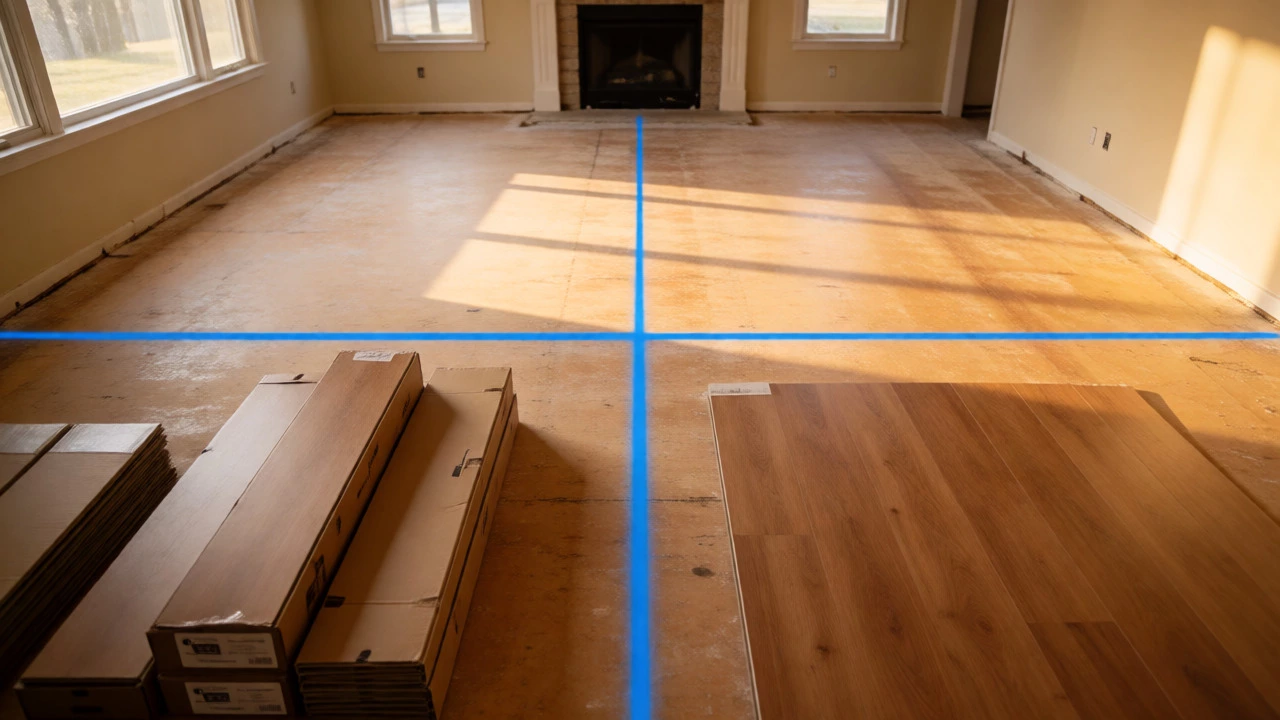
- Snap a chalk line connecting these midpoints. This is your central axis.
- Lay your first row of flooring parallel to this center line, not the wall. This ensures that any irregularities are distributed evenly on both sides of the room, rather than all piling up at one edge.
Applying the Rule to Different Flooring Types
Not all flooring behaves the same way when the room is out of square. Here’s how to adapt the 3-4-5 rule for common materials:
| Flooring Type | Best Starting Point | Risk if Ignored |
|---|---|---|
| Hardwood Planks | Longest continuous wall | Gaps widen exponentially toward the other side |
| Ceramic Tile | Center of the room | Cut tiles at edges look uneven and unbalanced |
| Vinyl Plank (LVP) | Most visible entryway | Staggered joints look chaotic near walls |
For vinyl plank flooring a synthetic flooring material designed to mimic the look of hardwood or stone, aesthetics often trump geometry. If the main entrance door opens into the room, start your rows parallel to that doorway’s sightline, then use the 3-4-5 rule to ensure the far end doesn’t drift too far off-square.
Common Mistakes When Using the 3-4-5 Rule
I’ve seen plenty of DIYers get tripped up here. The biggest error? Assuming one square corner means the whole room is square. A rectangle has four corners. If only one is 90 degrees, the others could be wildly off. Always check at least two adjacent corners.
Another pitfall is using a flexible tape measure incorrectly. Tapes can sag or stretch. For accuracy, hook the tape firmly into the corner mark and pull tight but not so hard that you distort the tape. Better yet, use a rigid 6-foot level or a framing square if you have one-they’re less prone to user error.
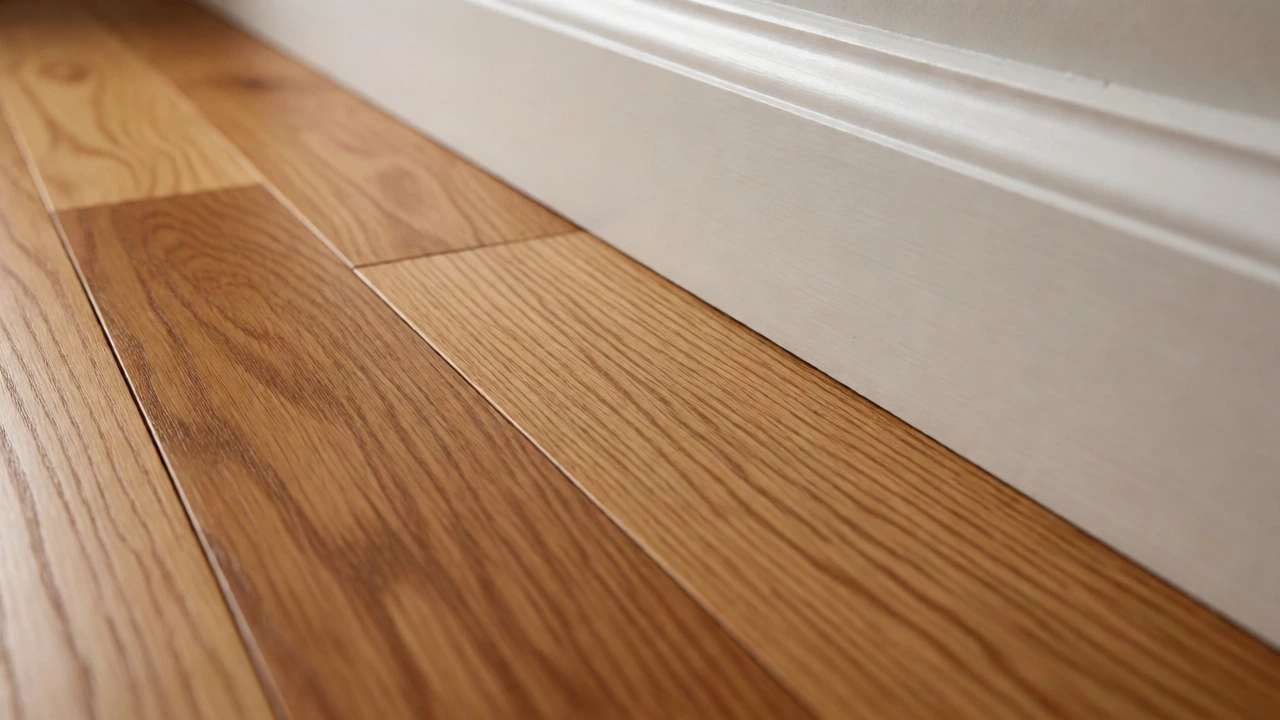
Also, remember that baseboards hide mistakes. If you’re removing old baseboards, you’ll see the raw wall edge. That’s your true reference point. Don’t trust the painted surface of the drywall if it’s been skim-coated unevenly.
Pro Tip: Scaling Up for Large Rooms
The 3-4-5 rule works great for small bathrooms or bedrooms. But what about a large open-concept living area? Measuring 3 feet and 4 feet might be too short to detect slight angular errors over a 20-foot span. In these cases, scale up the ratio. Use 6 feet, 8 feet, and 10 feet. Or even 9 feet, 12 feet, and 15 feet. The larger the triangle, the more sensitive it is to small deviations from 90 degrees.
If you’re working with engineered wood flooring a hybrid wood floor consisting of a top layer of real hardwood bonded to layers of plywood or high-density fiberboard, precision is key because the boards are often wider. A small angular error translates to a noticeable gap at the end of a wide plank. Use the scaled-up method here.
When to Ignore the Rule
Is there ever a time you shouldn’t care about squaring? Yes. If you’re installing carpet, the padding and tack strips can absorb minor irregularities. Carpet installers often just follow the longest wall because the fabric stretches. Similarly, if you’re doing a rustic barn-style plank floor with intentional gaps and rough edges, perfection isn’t the goal-character is.
But for anything with visible seams-tile grout lines, hardwood joints, laminate clicks-the 3-4-5 rule is non-negotiable. It’s the difference between a floor that looks professionally installed and one that screams "weekend project gone wrong."
Does the 3-4-5 rule work for circular floors?
No, the 3-4-5 rule applies specifically to rectangular spaces with right angles. For circular or curved floors, you’d typically use a compass or string-and-pencil method to establish radii and concentric circles rather than checking for 90-degree corners.
Can I use inches instead of feet for the 3-4-5 rule?
Yes, the ratio holds true regardless of unit size. You can use 3 inches, 4 inches, and 5 inches, or 3 meters, 4 meters, and 5 meters. However, smaller units like inches are less effective for detecting small errors over long distances, so feet or meters are preferred for room-sized checks.
What if my room is diamond-shaped?
If your room is a rhombus (diamond shape), no corner will pass the 3-4-5 test. In this case, focus on making the floor symmetrical relative to the room’s centerlines. Lay the floor parallel to the longest diagonal of the room to minimize awkward cuts at the walls.
Do I need special tools for the 3-4-5 rule?
Just a standard tape measure and a pencil. Some pros use a laser level for speed, but the 3-4-5 method is famously low-tech. A chalk line is helpful for marking the resulting square line, but it’s not strictly necessary for the measurement itself.
Will the 3-4-5 rule fix warped subfloors?
No, the 3-4-5 rule checks for angular accuracy (squareness), not flatness. A subfloor can be perfectly square but still have dips or humps. You’ll need a long straightedge or level to check for flatness separately before installing flooring.