Construction Industry Valuation Explorer
Select a company below to compare their financial metrics and business strategies. Data reflects approximate figures for the 2025-2026 period.
Vinci SA
PublicFrance • Concessions
ACS Group
PublicSpain • Infrastructure
Skanska AB
PublicSweden • Development
Fluor Corp
PublicUSA • Industrial Eng.
Bechtel Corp
PrivateUSA • Heavy Civil
Kiewit Corp
Employee-OwnedUSA • General Contractor
Select a Company
Strategic Advantage: The Concession Model
Vinci SA dominates the valuation rankings not just because they build, but because they own. By financing projects like toll roads and airports and then operating them, they generate recurring revenue streams that are highly predictable. This allows investors to value them similarly to utility companies rather than cyclical contractors.
- Key Strength: Diversified income from concessions (tolls, fees) reduces dependence on new construction bids.
- Risk Factor: High debt load due to asset ownership; sensitive to interest rate changes.
Valuation Drivers
Global Reach via Subsidiaries
ACS Group leverages its subsidiary Hochtief AG to maintain a strong presence in Europe and North America. Their model combines traditional contracting with infrastructure investment, allowing them to bid competitively while securing long-term returns through equity stakes in completed projects.
- Key Strength: Technical expertise in complex tunneling and high-rise construction.
- Risk Factor: Exposure to European economic fluctuations and regulatory shifts.
Valuation Drivers
Sustainability Leadership
Skanska has differentiated itself by focusing heavily on green building practices and safety. As governments worldwide mandate stricter environmental standards, Skanska's early adoption of these technologies gives them a competitive edge in public sector contracts, particularly in healthcare and commercial real estate.
- Key Strength: Strong brand reputation for safety and sustainability attracts premium clients.
- Risk Factor: Higher initial costs for green tech may compress margins if clients aren't willing to pay premiums.
Valuation Drivers
Energy Sector Dependency
Fluor Corporation's valuation is tightly coupled with the energy sector (oil, gas, LNG). While this provides massive revenue opportunities during boom cycles, it introduces significant volatility. Investors often discount Fluor's stock compared to diversified peers due to this cyclical risk.
- Key Strength: Deep expertise in complex industrial engineering and large-scale project management.
- Risk Factor: Highly sensitive to commodity price crashes and energy transition policies.
Valuation Drivers
The Private Giant
As a privately held company, Bechtel does not have a public market cap. However, its operational scale rivals the largest public firms. Its lack of quarterly earnings pressure allows it to pursue long-term, complex mega-projects that might be too risky or slow-returning for publicly traded competitors.
- Key Strength: Financial stability and ability to self-fund or partner on massive infrastructure without shareholder scrutiny.
- Risk Factor: Lack of transparency makes external valuation difficult; dependent on private credit markets.
Valuation Drivers
Employee-Owned Stability
Kiewit Corporation's employee-owned structure prioritizes long-term stability over short-term stock performance. Profits are reinvested into the company and distributed to employees, fostering a culture of efficiency and retention. This model builds internal equity rather than market cap.
- Key Strength: High employee retention and alignment of interests lead to consistent execution.
- Risk Factor: Limited access to public capital markets for rapid expansion compared to PE-backed competitors.
Valuation Drivers
You might think the biggest construction company is the one with the most cranes on a skyline. But when we talk about "worth," we are usually talking about money-specifically, how much investors would pay to own that business today. The answer isn't always who you expect. It’s not just about who builds the tallest skyscraper; it’s about who has the deepest pockets, the most stable contracts, and the smartest long-term bets.
The Bechtel Corporation often tops private lists for sheer operational scale, but in terms of public market capitalization (the stock price times the number of shares), European giants like Vinci SA frequently hold the top spot. Why? Because they aren't just builders; they are asset owners. They build highways, then they charge tolls on them for decades. That recurring revenue makes their valuation skyrocket compared to companies that only get paid once per project.
Defining "Worth": Market Cap vs. Revenue
Before we rank anyone, we need to clear up a common confusion. If you ask an engineer, they’ll tell you the biggest company is the one moving the most dirt. If you ask a Wall Street analyst, they’ll point to the company with the highest market capitalization. These are two very different things.
Revenue tells you how much cash flowed through the doors last year. It’s a measure of activity. Market cap tells you what the future looks like. Investors look at profit margins, debt levels, and growth potential. A company can have $50 billion in revenue but be worth less than a competitor with $30 billion in revenue if the first company is drowning in debt or operating on razor-thin margins.
For this ranking, we focus primarily on publicly traded companies because their value is transparent. Private companies like Bechtel or Kiewit don’t publish their full financials, so we rely on estimates from industry reports. As of late 2025 and into 2026, the landscape has shifted slightly due to inflation adjustments and infrastructure spending bills in the US and Europe.
The Undisputed Leader: Vinci SA
If you had to buy one ticket to the construction gold rush, many analysts would say it’s Vinci SA, a French multinational that dominates the global stage. Headquartered in Rueil-Malmaison, France, Vinci isn’t just a contractor. It’s a concession holder. This means they finance, build, and then operate airports, toll roads, and stadiums.
Why does this matter for valuation? Let’s say Vinci builds a toll road. They spend $1 billion to build it. Once it’s open, they collect tolls every day. That steady stream of cash flow is incredibly valuable to investors because it’s predictable. Compare that to a traditional contractor who finishes the road, gets paid, and has to scramble for the next job. Vinci’s model allows them to borrow cheaper and grow faster.
In recent fiscal years, Vinci’s market cap has hovered around €80-€90 billion, depending on currency fluctuations. Their strategy is simple: diversify. If construction slows down in Europe, they lean on their energy division or their concessions in Asia. This resilience is exactly why their stock price commands a premium.
The American Heavyweight: Fluor Corporation
Crossing the Atlantic, we find Fluor Corporation, based in Irving, Texas. For decades, Fluor was the go-to name for massive industrial projects, particularly in oil, gas, and mining. While its market cap fluctuates more wildly than Vinci’s-often sitting between $4 billion and $6 billion-it remains one of the most significant players in North America.
Fluor’s worth is tied heavily to the energy sector. When oil prices rise, demand for new refineries and LNG plants goes up, and Fluor’s backlog swells. However, this also makes them riskier. If energy markets crash, Fluor suffers. Investors know this, which keeps their valuation lower than diversified European peers. Still, Fluor’s expertise in complex engineering gives it a moat that smaller general contractors can’t cross easily.
The Infrastructure Kings: Skanska and Hochtief
Two other names consistently appear in the top five: Skanska AB from Sweden and Hochtief AG from Germany.
Skanska is famous for its sustainability focus. They were early adopters of green building practices, which has become a massive selling point as governments mandate stricter environmental standards. In the US, Skanska USA is a major player in commercial office buildings and healthcare facilities. Their commitment to safety and efficiency has earned them a loyal client base, stabilizing their earnings.
Hochtief, meanwhile, is part of the ACS Group, a Spanish conglomerate. Hochtief is a beast in tunneling and high-rise construction. They built some of the world’s most challenging tunnels, including sections of the Gotthard Base Tunnel in Switzerland. Their ability to handle technically difficult projects allows them to command higher fees, boosting their profitability and, consequently, their valuation.

Comparison of Top Construction Firms
To make sense of these numbers, let’s look at a snapshot of key metrics. Note that valuations change daily with stock markets, so these figures represent approximate ranges observed in the 2025-2026 period.
| Company | HQ Location | Primary Business Model | Approx. Market Cap (USD) | Key Strength |
|---|---|---|---|---|
| Vinci SA | France | Concessions & Construction | $95B+ | Recurring revenue from tolls/airports |
| ACS Group | Spain | Diversified Infrastructure | $35B+ | Global reach via Hochtief subsidiary |
| Skanska AB | Sweden | Development & Contracting | $15B+ | Sustainability leadership & US presence |
| Fluor Corp | USA | Industrial Engineering | $5B+ | Expertise in energy/mining sectors |
| Kiewit Corp | USA | Private Contractor | N/A (Est. $10B+) | Employee-owned stability & heavy civil |
Why Private Giants Like Bechtel Are Hard to Rank
You might wonder where Bechtel Corporation fits in. It’s arguably the most famous name in construction history, responsible for projects like the Hoover Dam and the Channel Tunnel. But because Bechtel is privately held, it doesn’t have a market cap.
Instead, we look at revenue. Bechtel regularly reports revenues exceeding $20 billion annually. In terms of raw work volume, it rivals or beats many public companies. However, without public stock trading, determining its exact "worth" requires guessing. Some industry experts estimate its enterprise value could exceed $20 billion, but this includes assets and liabilities that aren’t visible to outsiders.
Kiewit Corporation is another private giant. Based in Omaha, Nebraska, Kiewit is employee-owned. This structure affects its valuation logic. Employee-owned firms often prioritize long-term stability over short-term stock price spikes. They reinvest profits rather than paying dividends, which builds internal equity but doesn’t show up in a ticker symbol.
Factors Driving Valuation in 2026
So, what actually pushes a construction company’s value up? It’s not just winning bids. Here are the three levers investors watch closely:
- Backlog Quality: Not all contracts are equal. A fixed-price contract on a complex project is risky. Cost-plus contracts offer safer margins. Companies with large backlogs of profitable, low-risk work trade at higher multiples.
- Mergers and Acquisitions (M&A): The construction industry is consolidating. Large firms buy smaller, specialized ones to expand capabilities. Successful integration boosts value; failed mergers destroy it.
- Technological Adoption: Firms using Building Information Modeling (BIM) and drones for site surveys reduce errors and save time. Efficiency gains translate directly to better margins, which investors reward.
Another critical factor is labor availability. With skilled tradespeople in short supply globally, companies that have strong training programs or union partnerships face fewer delays. Fewer delays mean fewer penalty clauses triggered, protecting profit margins.
Regional Differences in Value
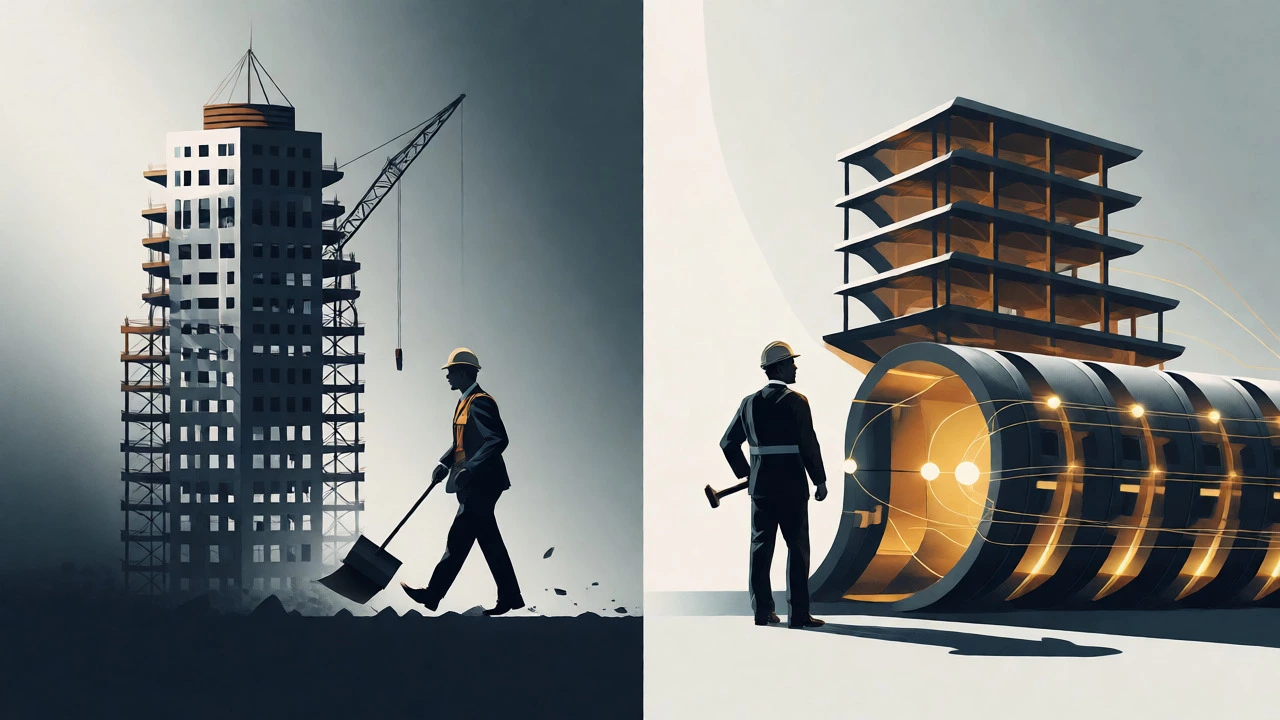
Geography plays a huge role in valuation. European companies tend to dominate the top spots because of their concession models. In contrast, US companies are often pure-play contractors. This structural difference explains why Vinci is worth so much more than Fluor, even if Fluor might move more concrete in a given quarter.
Asian companies like China State Construction Engineering Corporation (CSCEC) are massive by revenue. CSCEC often leads in total output, building entire cities in months. However, state ownership and opaque financial reporting make it hard for international investors to assign a precise market value. While CSCEC is undoubtedly "big," its "worth" in a Western investment context is harder to quantify compared to transparent European stocks.
How to Evaluate a Construction Company Yourself
If you’re looking to invest or hire a major partner, don’t just look at the logo size. Dig deeper. Check the current ratio (current assets divided by current liabilities). A healthy construction firm should have enough liquid assets to cover short-term debts. Construction is cash-flow intensive; running out of cash mid-project is fatal.
Also, look at the "days sales outstanding." How long does it take them to get paid? In construction, payment cycles can stretch to 60-90 days. Efficient companies manage this tightly. Poor management here signals operational weakness, regardless of how big the projects are.
Which construction company has the highest revenue?
China State Construction Engineering Corporation (CSCEC) typically holds the title for the highest annual revenue, often exceeding $250 billion USD. However, high revenue does not always equate to the highest market value or profitability.
Is Bechtel the richest construction company?
Bechtel is one of the largest private construction companies in the world. Since it is not publicly traded, it doesn't have a market cap. Its estimated net worth is substantial, but comparing it directly to public companies like Vinci SA is difficult due to lack of public financial data.
Why are European construction companies valued higher?
Many top European firms, such as Vinci SA and ACS Group, operate under a concession model. They build infrastructure and then own it, collecting tolls or fees for decades. This creates predictable, recurring revenue streams that investors value highly, leading to higher market capitalizations.
Does being the biggest builder mean being the most valuable?
No. Being the biggest builder refers to physical output or revenue. Being the most valuable refers to market capitalization, which depends on profitability, growth prospects, and risk profile. A smaller, highly profitable niche contractor can sometimes be more valuable per dollar of revenue than a massive, low-margin generalist.
What risks affect construction company valuations?
Key risks include material cost volatility (steel, lumber), labor shortages, interest rate changes affecting financing costs, and regulatory shifts. Additionally, reliance on cyclical industries like oil and gas or residential housing can lead to sharp valuation drops during economic downturns.
Final Thoughts on Industry Value
The race for the title of "most valuable" construction company is dynamic. Today, Vinci SA leads among public firms due to its smart asset-heavy strategy. Tomorrow, a shift in interest rates or a breakthrough in modular construction tech could change the leaderboard. If you’re watching this space, keep your eye on the balance sheets, not just the billboards. The real value lies in who can turn steel and concrete into sustainable, long-term cash flow.