Interior Design Career Path Estimator
Current Status
Key Terms
- CIDA: Council for Interior Design Accreditation
- NCIDQ: National Council for Interior Design Qualification exam
- Licensure: Legal permission to practice as an ID
Your Recommended Path:
Note: Requirements vary by jurisdiction. This estimator provides general guidance based on standard CIDA/NCIDQ pathways. Always verify with local regulatory bodies.
Walk into a sleek Vancouver high-rise lobby or a cozy West Coast cabin, and you’re seeing the result of someone’s deliberate choices. But here is the hard truth: calling yourself an "interior designer" without the right credentials can get your work shut down by building inspectors before you even hang a curtain. In many jurisdictions, including British Columbia and parts of the US, the title is legally protected. So, what degree actually gets you there?
If you want to practice professionally, handle commercial spaces, or touch structural elements, you need more than just a good eye for color. You need a specific educational path that leads to licensure. The short answer? A **Bachelor of Fine Arts (BFA)** or a **Bachelor of Science (BS)** in Interior Design from a CIDA-accredited program is the gold standard. But let’s break down why, and look at the alternatives if that isn’t quite your vibe.
The Gold Standard: CIDA-Accredited Bachelor’s Degrees
When we talk about the "best" degree, we are really talking about the most efficient path to becoming a licensed professional. The Council for Interior Design Accreditation (CIDA) is the global benchmark. If a program is CIDA-accredited, it means the curriculum meets strict standards for safety, codes, and technical skills.
Why does this matter? Because to sit for the NCIDQ exam-the National Council for Interior Design Qualification exam, which is required for licensure in most regulated areas-you generally need a combination of education and experience. A CIDA-accredited bachelor’s degree counts as the full educational requirement. Without it, you might spend years trying to prove your coursework was equivalent, or worse, find out you’re ineligible to take the test altogether.
| Degree Type | Focus Area | NCIDQ Eligibility | Best For |
|---|---|---|---|
| BFA in Interior Design | Creative, spatial theory, aesthetics | Yes (if CIDA-accredited) | Residential designers, concept-driven firms |
| BS in Interior Design | Technical, building systems, sustainability | Yes (if CIDA-accredited) | Commercial projects, corporate interiors |
| BA in Interior Design | Liberal arts context, history, theory | Variable (check accreditation) | Design historians, stylists, non-licensed roles |
| Master’s in Interior Design | Advanced specialization, career switchers | Yes (if CIDA-accredited) | Career changers with unrelated bachelor’s |
In Canada, while regulation varies by province, having a recognized degree is crucial for joining professional bodies like the Canadian Interior Design Association (CIDA - note the different acronym context here, often referring to provincial associations like IDABC in BC). Employers in major hubs like Toronto, Vancouver, and Montreal prioritize candidates who understand fire codes, accessibility standards (like the ADA in the US or local equivalents), and sustainable materials.
BFA vs. BS: Which Track Fits Your Brain?
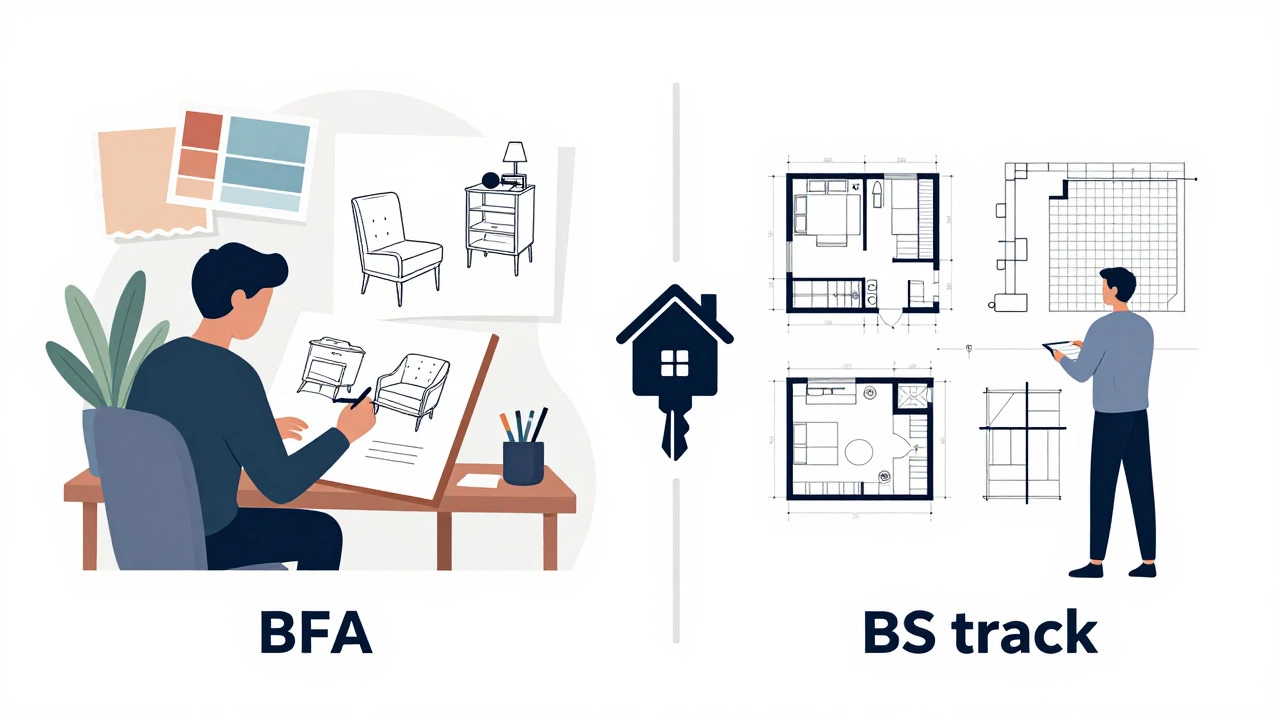
Not all bachelor’s degrees are created equal. You’ll typically see two main tracks: the Bachelor of Fine Arts (BFA) and the Bachelor of Science (BS). Both can lead to licensure if accredited, but they train your brain differently.
The BFA is heavy on studio time. You’ll spend hours sketching, modeling, and refining your aesthetic sensibility. It’s ideal if you see yourself working in high-end residential design, hospitality, or boutique firms where the "look and feel" drives the client relationship. You’ll learn how light interacts with texture, how color psychology affects mood, and how to curate spaces that tell a story.
The BS, on the other hand, leans into the engineering side of things. Expect more classes in building construction, HVAC systems, electrical planning, and environmental sustainability. This track is perfect if you love solving problems. Do you enjoy figuring out how to fit a kitchen into a weirdly shaped room while ensuring the plumbing lines up with the structural columns? Go BS. Commercial real estate developers and large corporate firms often prefer BS grads because they speak the language of architects and contractors fluently.
What About Architecture? Can You Switch?
A common question I hear is: "Should I study architecture instead?" Here is the distinction: Architects design the shell of the building. Interior designers design the life inside it. While there is overlap, an architecture degree (B.Arch) focuses on structural integrity, exterior envelopes, and urban planning. An interior design degree focuses on human behavior within spaces, ergonomics, material finishes, and interior lighting.
If you have an architecture degree, you can pivot to interior design, but you may need additional coursework to meet NCIDQ eligibility regarding interior-specific codes. Conversely, interior designers cannot sign off on structural changes. If you love both, consider a dual-degree program, though these are rare and intense. For most people aiming specifically at interior environments, a dedicated interior design degree is faster and more targeted.
The Career Changer’s Path: Master’s Degrees
Did you graduate with a degree in English, Biology, or Business and now realize you’ve been rearranging furniture since childhood? Don’t panic. You don’t need to go back for four years. Many top universities offer accelerated Master’s in Interior Design programs specifically for career switchers.
These programs are intensive-often two years-but they condense the core curriculum into a fast-paced format. They assume you already have general college skills (writing, critical thinking) and dive straight into space planning, CAD software, and material science. Look for programs that are CIDA-accredited. If you complete one of these, you become eligible for the NCIDQ exam just like your peers who started with a bachelor’s in the field.
This route is particularly valuable if you bring unique skills from your previous career. A former nurse might excel in healthcare interior design, understanding patient flow and infection control better than a traditional art student. A former marketer might nail the branding aspect of retail store design.
Online Degrees: Legit or Loophole?
With the rise of remote learning, online interior design degrees have exploded. Are they legitimate? Yes, but with a massive caveat: accreditation.
If an online program is CIDA-accredited, it holds the same weight as an on-campus degree. However, very few fully online programs hold this accreditation because interior design requires hands-on studio critique, physical model-making, and site visits. Most "online" degrees are either:
- Hybrid: Online lectures with mandatory weekend intensives on campus for studio work.
- Non-accredited: These teach you software and styling but will not help you get licensed. They are great for home staging or freelance decorating, but useless if you want to work on commercial contracts requiring sealed drawings.
Before paying tuition for an online program, verify its accreditation status directly on the CIDA website. Do not trust the university’s marketing page alone. If it’s not listed, it’s likely a decorative arts certificate, not a professional design degree.

Essential Skills Beyond the Classroom
Your degree gets you the license, but your toolkit keeps you employed. Modern interior design is less about pulling fabric swatches and more about digital precision and project management. Here is what you must master alongside your coursework:
- AutoCAD & Revit: AutoCAD is the industry standard for 2D drafting. Revit (Building Information Modeling) is taking over for 3D coordination. If you can’t navigate Revit, you’ll struggle in any mid-to-large firm.
- SketchUp & Enscape: For quick 3D modeling and real-time rendering. Clients need to visualize spaces before they’re built.
- Adobe Creative Suite: Photoshop for presentation boards and Illustrator for custom graphics or floor plans.
- Building Codes: This is the boring part that saves lives. Learn about egress widths, fire ratings, and accessibility ramps. Ignorance here isn’t cute; it’s illegal.
- Sustainability Certifications: Familiarize yourself with LEED or WELL Building Standards. Green design is no longer a niche; it’s a requirement for many commercial clients.
Is a Degree Worth the Investment?
Let’s talk money. A four-year degree costs tens of thousands of dollars. Is it worth it? If you want to be a licensed interior designer, yes. The salary gap between licensed professionals and unlicensed decorators is significant. Licensed designers can charge higher fees, take on larger commercial projects, and work independently. Unlicensed individuals are often restricted to residential styling or must work under the supervision of a licensed designer.
However, if your dream is solely to style homes for Instagram or consult on paint colors, a formal degree might be overkill. In that case, a certificate program or self-study in color theory and soft furnishings might suffice. But know your limits. Never attempt to alter load-bearing walls or reconfigure electrical layouts without proper training and licensure.
Next Steps for Aspiring Designers
If you’re ready to pursue this path, start by researching CIDA-accredited schools near you or those offering strong hybrid options. Attend open houses. Talk to current students. Ask them about their internship opportunities. Internships are critical-they bridge the gap between classroom theory and real-world chaos. Look for programs that have partnerships with established firms in cities like Vancouver, New York, or London.
Also, join student chapters of professional organizations like ASID (American Society of Interior Designers) or your local provincial association. Networking starts early. The person you sit next to in your lighting design class today could be your future business partner tomorrow.
Can I become an interior designer without a degree?
In some regions, you can gain eligibility for licensure through extensive work experience combined with non-accredited education, but this path is much longer and harder. Most employers require a degree, and without a CIDA-accredited degree, you may be ineligible for the NCIDQ exam, which is the primary credential for professional practice.
What is the difference between an interior decorator and an interior designer?
An interior decorator focuses on aesthetics: fabrics, colors, furniture arrangement, and accessories. They do not alter structures. An interior designer is trained in space planning, building codes, safety regulations, and construction documents. Designers can move walls, change lighting fixtures, and ensure compliance with legal standards.
Is a Master’s degree necessary for interior design?
No, a Bachelor’s degree is sufficient for entry-level positions and licensure. A Master’s is primarily for career changers who already have a bachelor’s in another field, or for those seeking advanced specialization in areas like healthcare or exhibition design.
How long does it take to become a licensed interior designer?
Typically, it takes 4 years for a bachelor’s degree, followed by 2-3 years of supervised work experience, and then passing the NCIDQ exam. If you pursue a master’s after an unrelated bachelor’s, add 2 years for the degree plus the experience requirement.
Are online interior design degrees respected by employers?
Only if they are CIDA-accredited. Most fully online programs are not accredited because they lack the required studio components. Hybrid programs with on-campus intensives are more widely accepted. Always verify accreditation before enrolling.