When people think about construction, they often picture hard hats, loud jackhammers, and piles of lumber. But behind all that noise is a quiet truth: some construction trades make more money, offer more stability, and give you more freedom than others. If you're wondering what the best trade in construction is, the answer isn’t about which one looks the coolest on Instagram. It’s about which one gives you the best return on your time, effort, and skill.
Electricians Are in Constant Demand
Every new house, every office building, every solar panel installation - they all need electricity. And that means electricians are always needed. In 2025, the U.S. Bureau of Labor Statistics reported over 700,000 electrician jobs nationwide, with demand growing 7% annually. That’s faster than most other trades. Why? Because homes are getting smarter. Wiring for EV chargers, smart thermostats, and home automation systems isn’t optional anymore - it’s expected. A licensed electrician can charge $75 to $125 per hour, and experienced ones working on commercial projects often clear $100,000+ a year. You don’t need a college degree. You need a four-year apprenticeship, a license, and the patience to read blueprints. But once you’ve got it, you’re never out of work.
Plumbers Don’t Just Fix Leaks
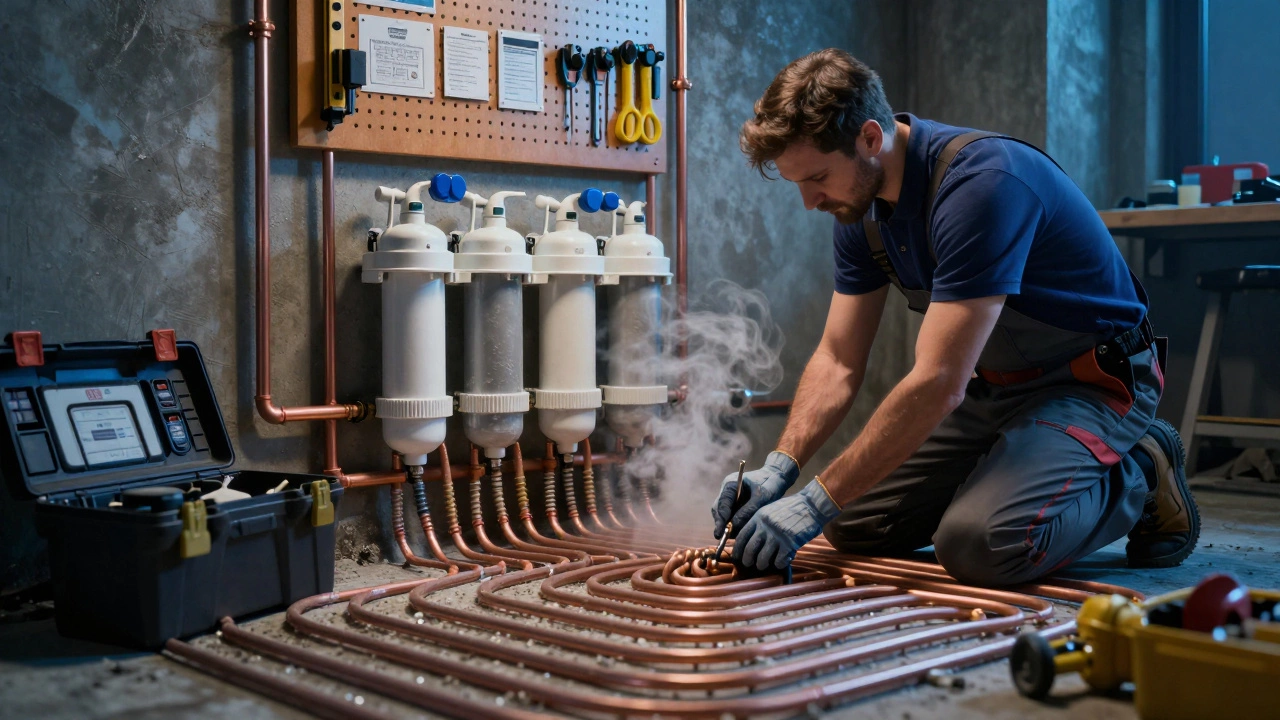
Plumbing is older than electricity, but it’s just as essential. And it’s getting more complex. Modern plumbing includes water purification systems, radiant floor heating, greywater recycling, and compliance with strict green building codes. Plumbers in cities like Chicago or San Francisco earn between $80 and $140 an hour. In rural areas, they’re still making $60-$90, but with far less competition. The biggest perk? You can work for yourself. Many plumbers start as apprentices, then buy a van, get a license, and open their own shop within five years. No landlord. No boss. Just you, your tools, and your schedule. And unlike some trades, plumbing doesn’t rely on economic booms - people always need clean water and working toilets.
Ironworkers Get Paid to Work High Up
If you’re not afraid of heights, ironworking might be the most thrilling and well-paid trade in construction. Ironworkers assemble the steel skeletons of skyscrapers, bridges, and stadiums. They earn an average of $55,000 to $95,000 a year, but those numbers jump quickly with overtime and hazard pay. In New York or Los Angeles, it’s not uncommon for experienced ironworkers to make over $120,000 annually. The catch? It’s physically brutal. You’re climbing 50 stories with 50-pound steel beams strapped to your back. You need to be in top shape. But if you are, you’ll find a tight-knit crew, steady union work, and benefits most other trades don’t offer.
Sheet Metal Workers Are Everywhere - You Just Don’t Notice
Sheet metal workers install HVAC ducts, roofing systems, and custom metal facades. They’re the hidden backbone of comfort in modern buildings. Their work doesn’t get the spotlight, but it’s critical. In 2025, the median salary was $58,000, but skilled workers in high-demand markets like Boston or Seattle made $80,000+. What makes this trade stand out is versatility. You can work on hospitals, data centers, or luxury condos. You can even specialize in energy-efficient ductwork, which is in high demand due to new building codes. And because you’re not tied to one type of project, you can pivot between residential, commercial, and industrial jobs as the market shifts.
Why Carpentry Isn’t the Best - Even Though It’s Popular
Carpentry is what most people imagine when they think of construction. And sure, it’s a solid trade. But it’s also the most saturated. There are thousands of carpenters, and many work for general contractors who pay by the job, not by the hour. That means your income depends on how fast you work - not how good you are. Entry-level carpenters often make $20-$25 an hour. Even experienced ones rarely break $40 without going into custom cabinetry or high-end remodels. And with prefab materials and modular construction rising, traditional framing work is slowly shrinking. If you’re good with your hands and love wood, carpentry is rewarding. But as a financial investment in your future? It’s not the top choice.
What About Welding? Is It Still Worth It?
Welding used to be the golden ticket. Not anymore. While welding is still needed in shipyards, pipelines, and manufacturing, automation has eaten a big chunk of the market. Robots now do 60% of the welding in car factories. That means fewer entry-level jobs. But specialized welders - the ones who work on offshore oil rigs, nuclear plants, or aerospace components - still make $70-$100 an hour. The problem? Those jobs require certifications you can’t get in a weekend. You need AWS, ASME, or API certs, which take months and cost thousands. If you’re willing to invest the time and money, welding can pay off. But for most people, it’s not the fastest or easiest path to a good income.
The Real Winner: Electricians and Plumbers Tie for First
So what’s the best trade? It’s not one. It’s two. Electricians and plumbers are tied for the top spot - and for good reason.
- Both require licensing, which protects your income from unqualified competition.
- Both can work for themselves after 4-5 years.
- Both earn more than $60,000 a year even in small towns.
- Both are immune to automation - no robot can replace a human diagnosing a faulty circuit or a hidden leak.
- Both are needed in every building, every year, no matter the economy.
Electricians have a slight edge in growth because of renewable energy trends. Plumbers have a slight edge in simplicity - fewer tools, fewer permits, fewer inspections. But both are safe, profitable, and future-proof.

How to Start Without Going Into Debt
You don’t need to take out $30,000 in student loans to get into either trade. Most apprenticeships are paid. You earn while you learn. In fact, many electrician and plumbing apprenticeships pay $15-$25 an hour from day one, with raises every 6 months. After four years, you’re a journeyman. You can work for a company - or start your own. Community colleges often offer prep courses for under $1,000. The only real cost is your time and willingness to show up every day.
What to Avoid
Don’t chase trades that sound glamorous but have little long-term demand. Roofing? High injury rates, seasonal work, and brutal heat. Demolition? Short-term contracts, unstable pay. Tile setting? Overcrowded market, low margins. Stick with the trades that are built into the foundation of modern life: power, water, and air. Those aren’t going away.
Final Thought: It’s Not About the Tool - It’s About the System
The best trade in construction isn’t the one with the flashiest truck or the most Instagram likes. It’s the one that’s embedded in every building, every city, every home. It’s the one that keeps the lights on and the water running. That’s why electricians and plumbers will always be in demand. They don’t just fix things - they keep civilization running. And that’s worth more than any paycheck.
Is construction a good career path in 2026?
Yes, especially in skilled trades. The average age of construction workers is over 45, and not enough young people are entering the field. That means high demand, strong wages, and job security for the next 15-20 years. Electricians and plumbers are seeing 7-9% job growth annually - far above the national average.
Can I start a construction trade without a degree?
Absolutely. You don’t need a college degree. Most trades require a high school diploma or GED, then a 4-year apprenticeship. You’ll get paid while you learn, and you’ll earn a license at the end. Many community colleges offer prep courses for under $1,000. The real requirement is reliability, physical stamina, and the willingness to learn.
How much do electricians make in 2026?
Entry-level electricians earn $45,000-$55,000 a year. Journeyman electricians make $65,000-$85,000. Those working on commercial or industrial projects, especially with solar or EV expertise, can earn $90,000-$120,000. In high-cost cities like San Francisco or New York, top earners make over $140,000 with overtime.
Is plumbing harder than electrical work?
It’s not harder - it’s different. Plumbing involves more physical lifting and working in tight, dirty spaces. Electrical work requires more precision, reading complex diagrams, and understanding code updates. Both demand problem-solving skills. Most apprentices say the first year is the toughest for both. After that, it’s about experience, not which one is harder.
What’s the fastest way to start earning in construction?
Start as a laborer or helper for an electrician or plumber. You’ll learn the ropes, build relationships, and often get offered an apprenticeship within a year. Many contractors hire helpers who show up early, work hard, and ask questions. Within 3-4 years, you can be a licensed journeyman. That’s faster than any college degree and you’re earning the whole time.
If you’re serious about a career in construction, don’t wait for the perfect moment. The best time to start was yesterday. The second-best time is today. Pick one trade - electrician or plumber - and find a local union or contractor offering apprenticeships. Show up. Learn. Stay consistent. In five years, you won’t be wondering if it was worth it. You’ll be living the answer.